
Photo Documentation by Emmanuel Nwafor
It was a privilege to partake in a six-week Moving Image Residency at padà - a wonderful cultural and community-focused institution, nestled in a historic and vibrant corner of Lagos Island, Nigeria.
My time there was spent deep in research, tracing the multi-faceted lineages of storytelling within Nigeria, focusing on the history of film within the country and how this connects to traditional mediums of ‘mythmaking’ (particularly within the Yoruba cultural and traditional contexts), as well as the ways storytelling reaches audiences across the nation - past, present and future.
This work culminated in an open studio session followed by a case-study screening of Jean-Marie Téno’s “Lieux Saints” - a Burkinabe film shot in the shadows of FESPACO - exploring how cinema can be a pillar for integrated community building. A free focus group including Lagosian filmmakers, producers and other actors in the space was also held after the screening.
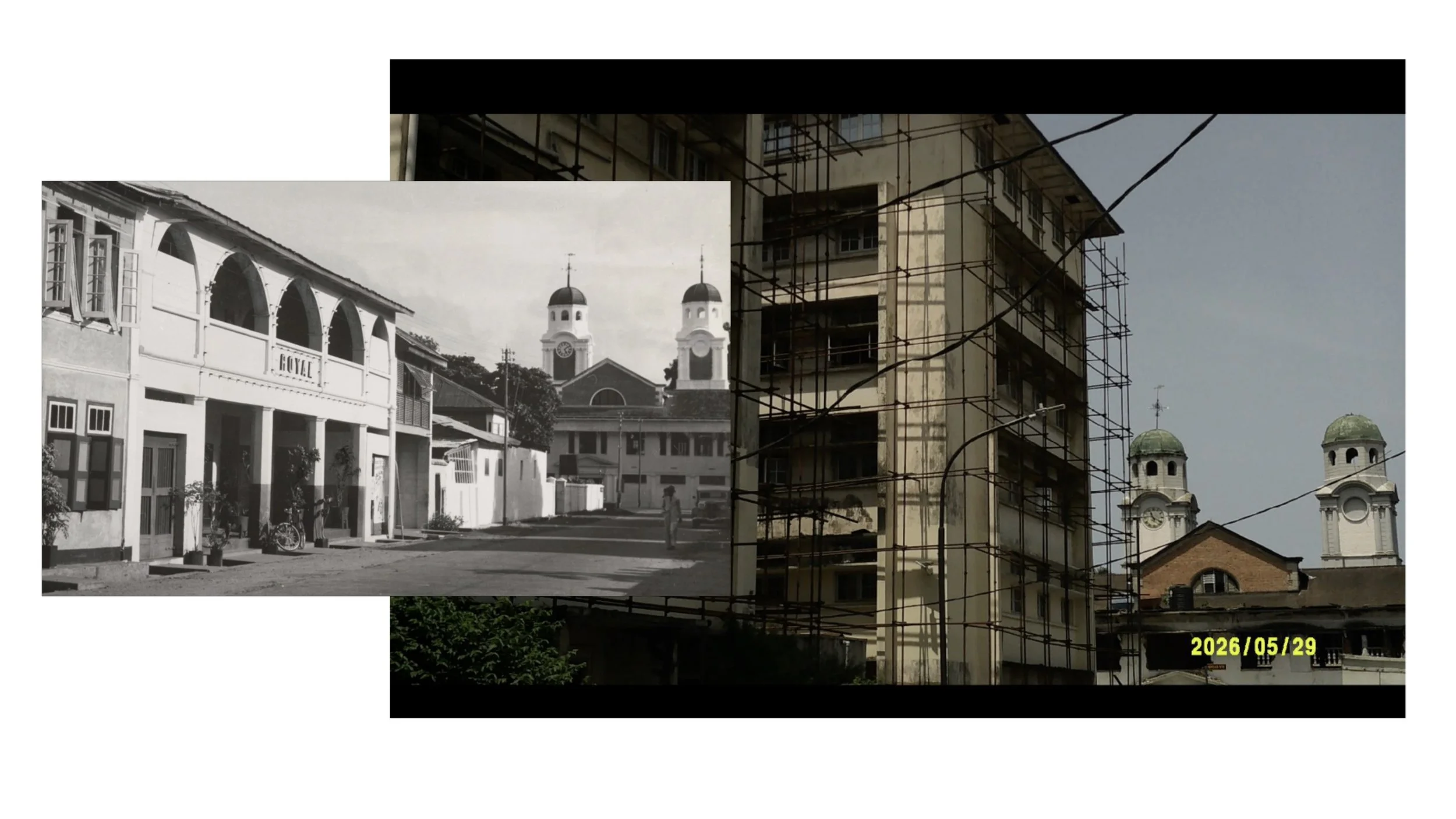
Visual comparison: Archival image of the old Royal Cinema on Joseph Harden Street (now Mobolaji Bank Anthony/Broad Street), which would overlook the two clock towers at the Colonial Secretariat on Marina Road between 1930-1960. The cinema has since been demolished but the view of the old secretariat from a similar vantage point remains.
A key highlight of this residency was the ability to apply my research beyond the ‘studio’ or workspace and instead move through Lagos Island by adopting a form of ‘walking cartography’, partly inspired by the work of researcher Ademide Adelusi-Adeluyi and the exploratory ‘open-world’ concepts of video games like The Witcher or Ghost of Tsushima. This allowed me to construct maps and plot real places and spaces in current time, and then, connect these physical locations with historical, speculative or conceptual reflections - thus engaging with archives and the hyper-local community in a multi-sensory and multi-temporal fashion.
Accompanied by members of the padà team, we walked a course through time and space, making several stops from the historic Glover Memorial Hall and Tafawa Balewa Square to more humble, local screening clubs on Campos and Berkley Street, uncovering legacies of story telling and observing the varied ways Lagosians have and continue to engage with stories, film, visual medias and moving images.


The residency took place over six weeks, from May to June (2026).

A handycam still-shot of ‘Waka Club’ on Campos Street, taken during the walking tour of Lagos Island.
padà launched their PARC (Pan-African Research Centre) in February of this year. It houses a small yet rich library of reading materials, images and textual archives documenting Nigerian histories, culture, languages, works of fiction, theatre, poetry, maps and more, alongside the broader histories, cultures and intellectual contributions of Black and African peoples across the diaspora.
When I first began my residency I set out a few objectives.
(1) Explore audio-visual archives within the Black/African, but also specifically Nigerian landscapes.
(2) Investigate ways to engage with film and arts curation alongside Pan-African archives (with the help of the PARC).
(3) Generate ideas for: (1) the use of film as a community-focused tool (2) the use of film and sound in public spaces, (3) the creation of a filmic archive, etc.
*
In sum, I hoped to further develop and deepen my understanding of film and moving-image as well as explore different methodologies for archival research and audio-visual arts curation & programming.
What followed was far more expansive than I had expected. I am always thinking about - and often affirm that my practice encompasses - film, form, movement and sound. In light of this, and thanks to the materials available to me (as well as conversations held with members of the padà team spanning music, gaming, politics, food etc), I began to construct a fantasy, envisioning padà like a home base from which adventure could spawn. Like a video game character I charted courses, sometimes through time with reading and watching, and in other cases physically across Lagos Island, moving from place to place, collecting data, passing checkpoints and levels to achieve my objectives.
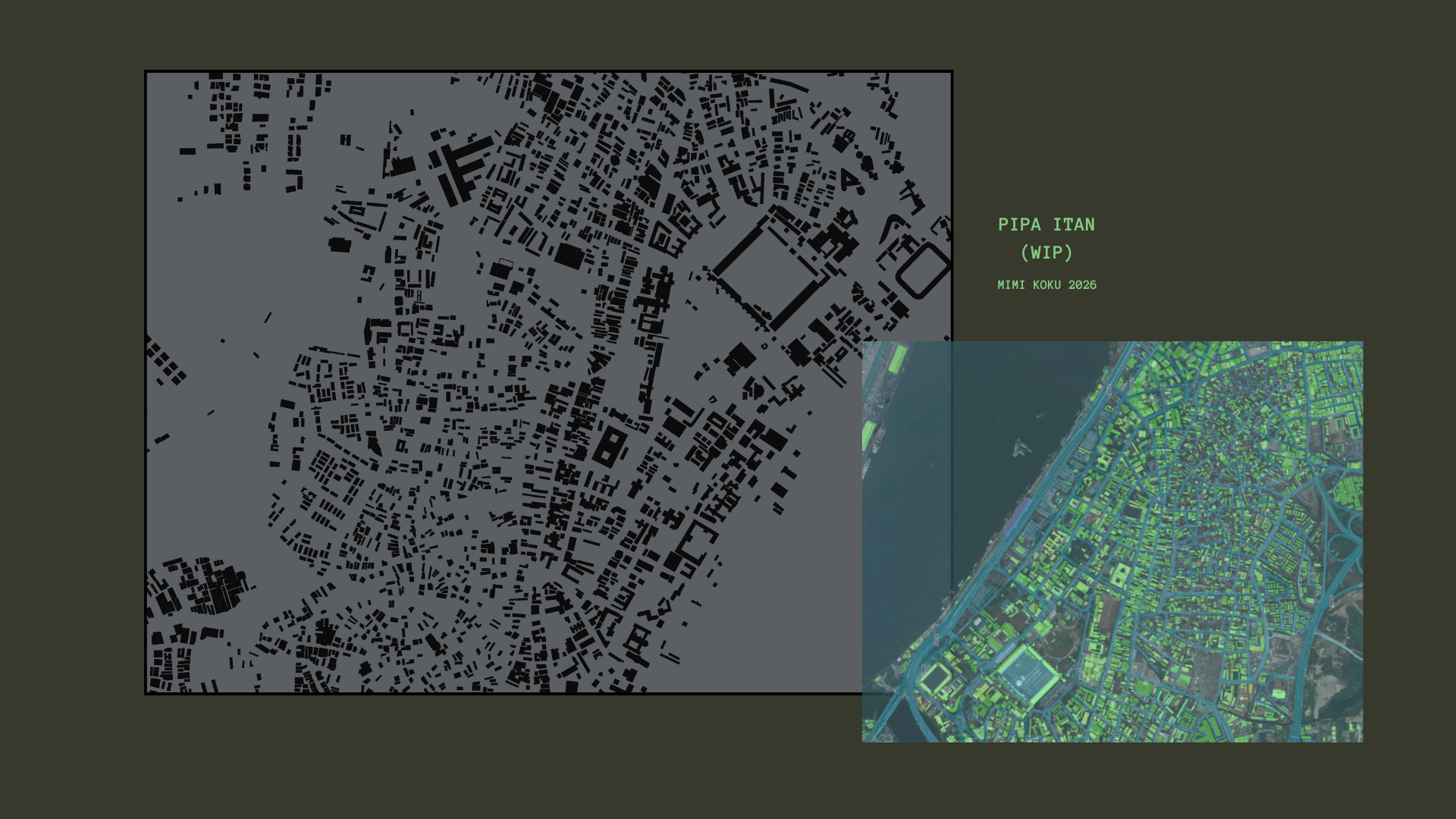
Digitised maps of Lagos Island, Render 001 - PIPA ITAN (WIP)
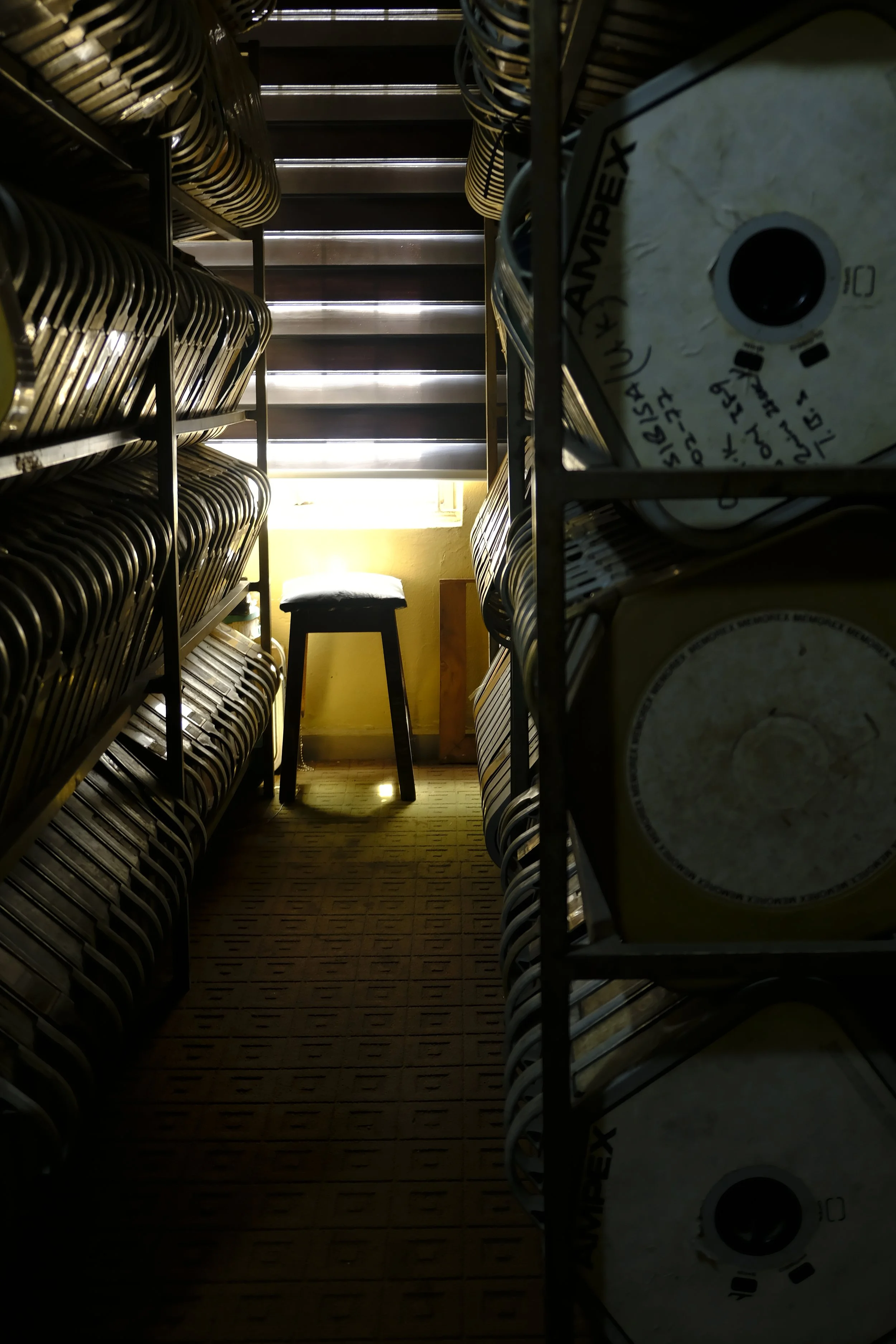
Festac ‘77 Archives at the CBAAC, Lagos Island.
With these experiments and investigations, I have since reflected on the varied ways to approach artistic research. I am continuing to appreciate that art-making is not solely a task towards the “completion of ideas evident in the work”.
It is also ritual, it is habit. It is process and study. It is a way of seeing and it is re-learning, assembling, de-constructing and re-constructing.
It is in conversation and it is on location.
It is imagining and it is fantasy.
This was an opportunity for fellowship with like minds and communion with a city that is filled with so many memories (mine own and those of others). Art-making becomes a playful conversation - in this case with home, with time and with history.
I couldn’t be more grateful and I am freshly inspired because now there are new threads to unravel and to weave into this ever-expectant “work”.
Learn more about padà and the work they do here.